
5,000 Meals a Day. And the One Question I Ask Myself as CEO Every Time.
For an operation serving 5,000 meals a day, it is not enough for the design to work on paper. It has to work for the long term. Here is how we approached the foodservice facilities at Panasonic's production site in Pilsen.
When a new project lands on my desk, it usually starts the same way: a 2D layout. Everything fits, the standards are met and the logic works on paper. The project is "correct".
And that is exactly the moment when, after years in this field, I ask myself the question that decides everything that follows:
Will it simply work, or will it work for the long term?
There is a huge difference between the two. And for an operation with a capacity of 5,000 meals a day, that difference is no longer academic. It is economic, operational and human.
Why I stopped relying on 2D drawings alone
A 2D drawing is not bad. It is fast, clear and familiar to everyone. But it will not show you reality:
- it will not show you the pressure of peak service,
- it will not show you the unnecessary steps your staff take,
- it will not show you where the operation starts to slow itself down,
- and above all, it will not show you mistakes before they start to hurt.
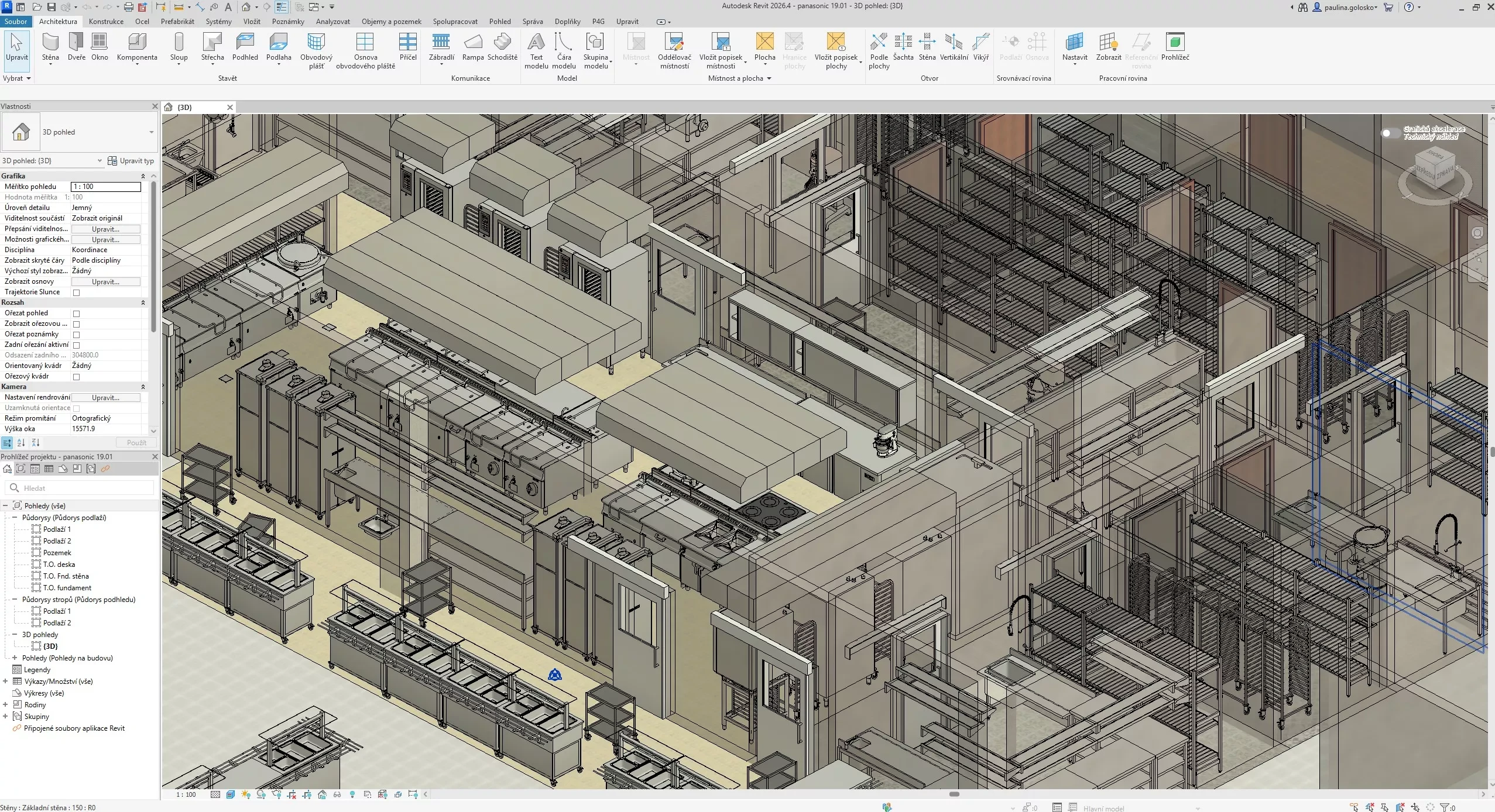
That is why, on larger projects, we move into a BIM model very early. Not because it is a trend, but because it is the most sensible form of risk prevention available today.
In Autodesk Revit, we can afford to be uncomfortably thorough. We follow the flow of ingredients, the movement of people, ergonomics, clashes and the logic of the entire operation. Above all, we can afford to make mistakes, because a mistake in the model does not cost millions.
A mistake in BIM is annoying. A mistake on site is expensive and personal.
Investors don't want to hear "trust us". They want to see it.
Over time, I have learnt one more thing: neither investors nor developers want to read drawings. And frankly, they shouldn't have to.
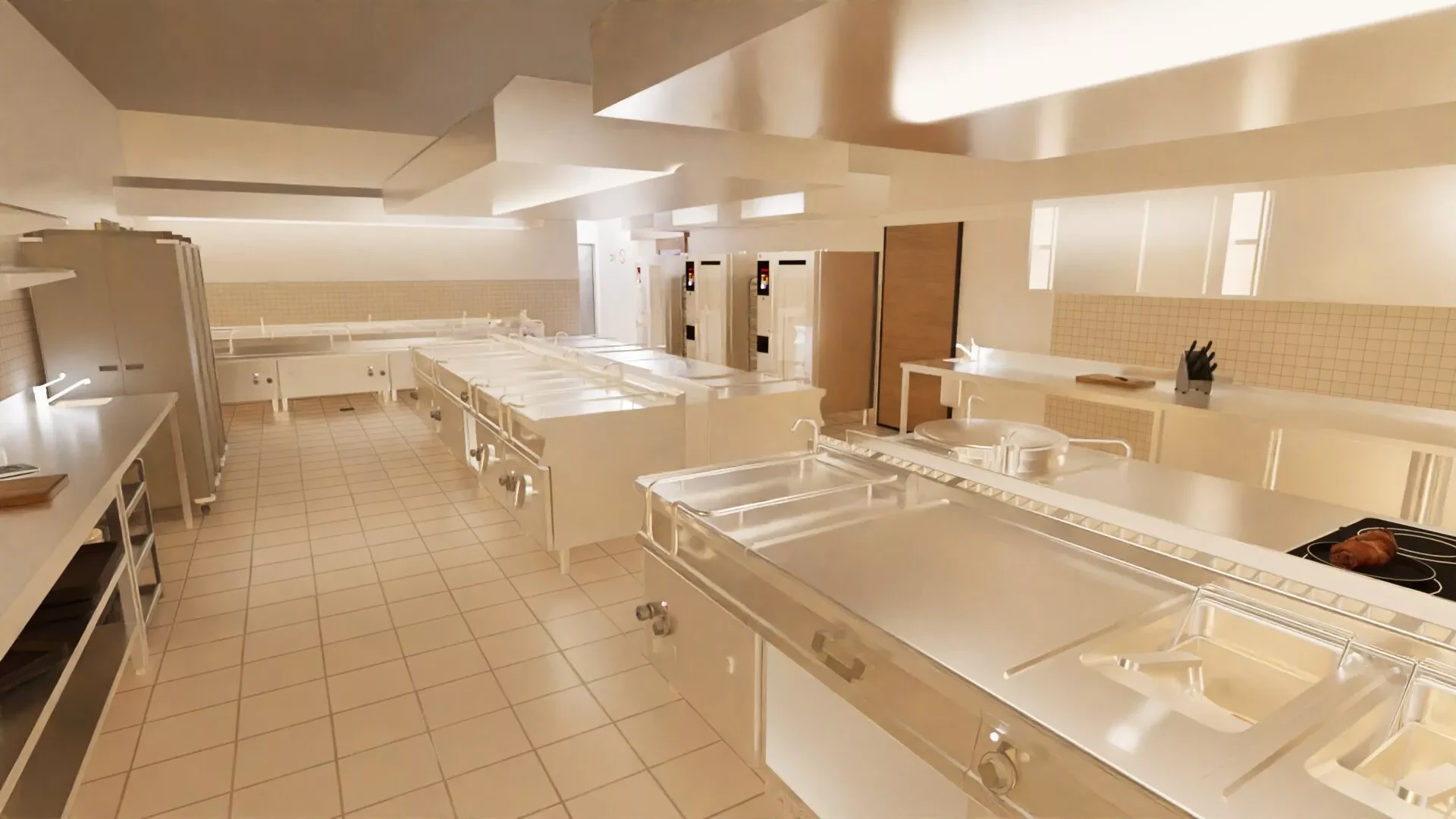
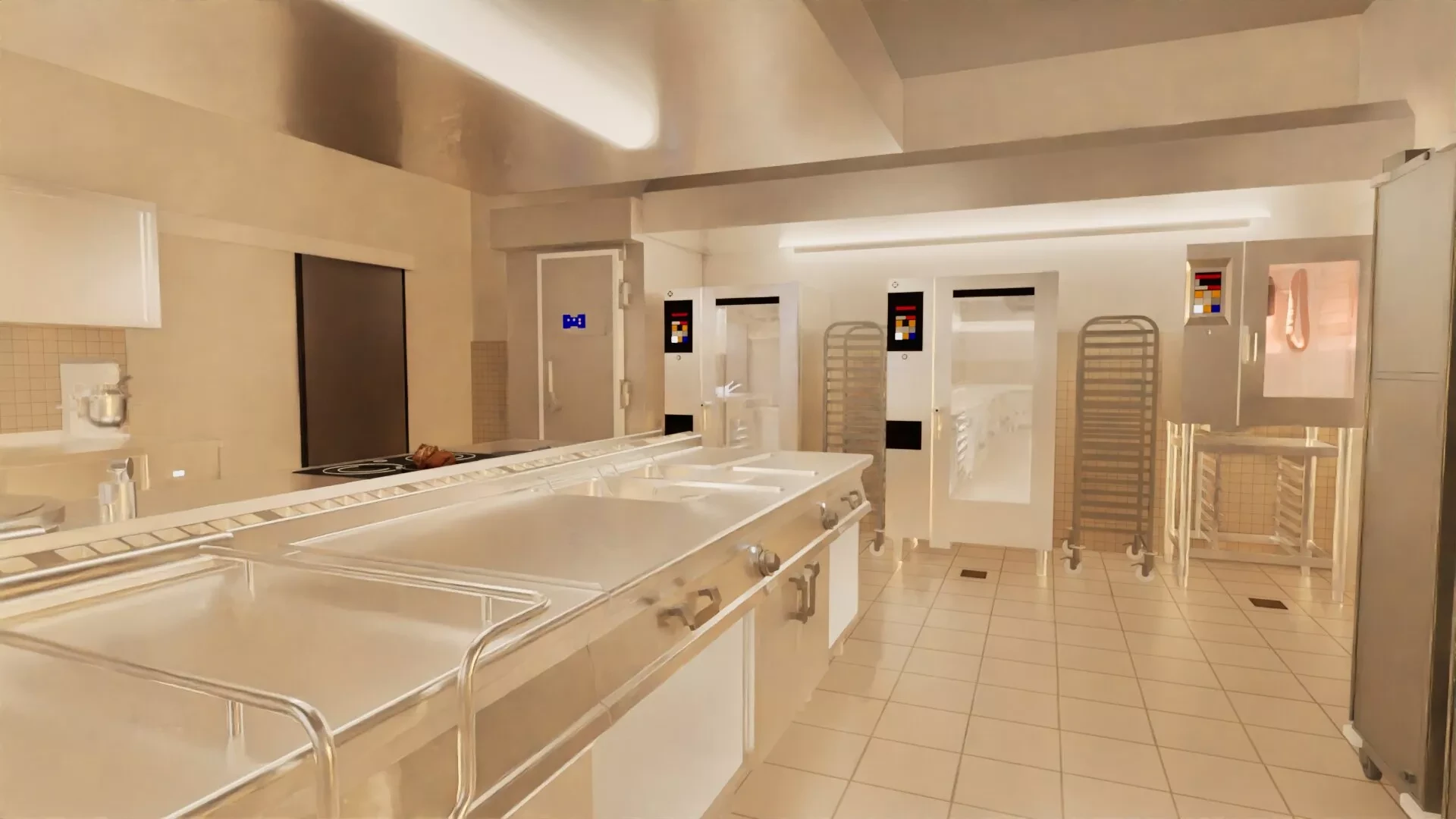
So we take the BIM model further, into visualisations and virtual reality in Twinmotion. Suddenly the conversation changes. You can see the space, the operation and how everything connects. Decisions are no longer based on gut feeling, but on understanding.
And this is often where the changes that save the most money are made. Before construction begins.
What this project was really about
The brief was clear: design a foodservice operation for 5,000 meals a day that can handle reality, not an ideal day. That meant:
- clearly separated zones for storage, preparation, cooking and warewashing,
- clear relationships between them,
- uncompromising hygiene,
- an operation that does not collapse at peak times.
At this scale, a kitchen is not a piece of technology. It is a process. And a process either works or it does not work at all.
Pilsen. Panasonic. And a great deal of responsibility.
We delivered the project for Panasonic's production site in Pilsen. It is one of the most technologically advanced foodservice facilities we have worked on recently. I enjoy projects like this. Not because they are big, but because they do not forgive shortcuts.
This result is not about software. It is about people.
You can have the best tools in the world, but without the right people they are useless.
I am proud of my team, and of Paulína Golosko in particular, who handles projects of this scale calmly and precisely. She can see a project through the eyes of the designer, the operator and the investor at the same time. That is a combination you cannot learn overnight.
Many thanks also go to Controlis and its CEO, Martin Slanec. Their tools and technical support allow us to work precisely, thoroughly and without compromise. In our field, that is a huge advantage.
A personal closing note
We are a foodservice design practice, but we think like investors. And we work so that we can still put our
name to the result years from now.If I had to sum up this article in one sentence:
The best return on a project does not begin on site. It begins with the decision about how you design it.
Planning a high-capacity kitchen or workplace catering? Get in touch and let's talk about your project before construction begins.
Luboš Prüger
CEO, Projects 4GASTRONOMY