
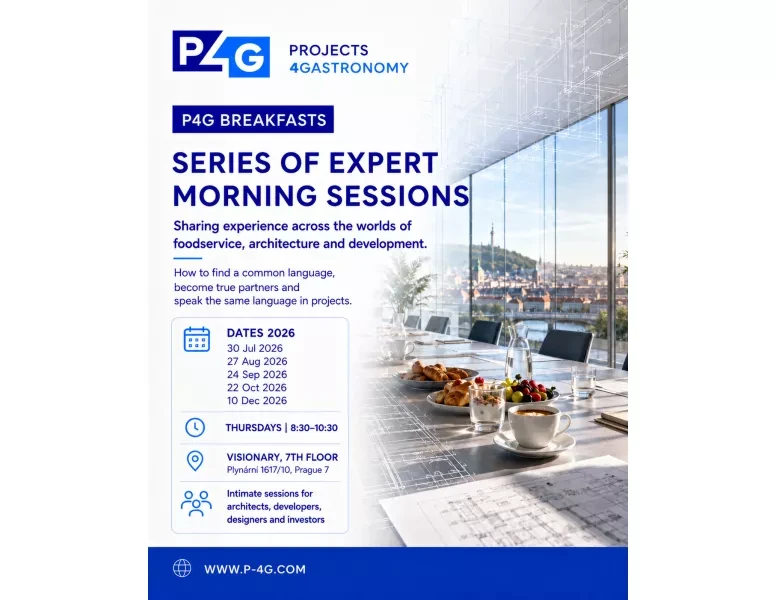
P4G Breakfasts: When Architecture, Investment and Foodservice Start Talking Early ☕️
Expert morning sessions for architects, developers, investors, designers and foodservice professionals
Foodservice operations often enter a project far too late.
Usually at the point when the concept has already been approved, floor areas are fixed and the architectural direction is clearly defined. Only then do questions start to appear: where will the kitchen, storage, serving line, dishwashing, deliveries, waste, staff changing rooms, toilets, technical infrastructure and back-of-house facilities actually fit?
And that is usually where changes begin — changes that cost time, money and energy for everyone involved.
That is why we created P4G Breakfasts. ☕️
Not as a traditional business breakfast or a presentation of equipment. But as a regular, small-format series where people who influence how foodservice projects will work in reality can meet and talk openly.
Architects. Investors. Developers. Designers. BIM coordinators. Operators. Foodservice professionals. ?
Because every one of them sees the same project differently.
The investor looks at return on investment, capacity, budget and opening deadlines.
The architect looks at concept, atmosphere, space, materials and the guest experience.
The foodservice operator looks at the movement of ingredients, staff, technology, service, dishwashing, deliveries, hygiene, timing and everyday performance.
A good project starts when these worlds stop fighting over square metres — and start talking to each other.
Foodservice Is Not Just Equipment on a Floor Plan ?️
A well-designed foodservice operation is not simply about how much equipment can fit into a kitchen.
It is about whether the space will genuinely work.
Will the kitchen handle the required capacity? Can staff move and communicate naturally? Can deliveries get from the loading area all the way to storage? Can a pallet truck actually turn where it needs to? Is storage sufficient without occupying expensive, unused floor area? Does the bar connect properly to service? Are guests, staff, clean dishes, dirty dishes and waste all forced to use the same route?
In practice, we often see two opposite extremes.
On one side, there is an operation expected to deliver high performance with far too little space. The kitchen may be expected to prepare hundreds of meals, yet there is not enough room for production, service, storage, dishwashing, staff or technology.
On the other side, there is an operation that is unnecessarily oversized. Staff barely see each other across the kitchen, walk unnecessary distances during every shift, communication becomes slower and every additional square metre increases both investment and operating costs.
A small space suffocates operations.
A large space suffocates economics.
The purpose of P4G Breakfasts is to open these discussions early — ideally during the concept stage, when projects can still be adapted without unnecessary compromises.
We Will Talk About the Real Reality of Projects ?
At each session, we will open specific topics based on real P4G experience.
We will work with live lessons from practice, operational situations, layout dilemmas, ingredient flows, capacity requirements, technology and coordination between disciplines. Always with respect for our clients and confidential information, but openly enough for every participant to take away practical insight for their own projects.
This is not about showing how much equipment can fit into a floor plan.
It is about understanding how space, people, technology, the investor’s vision, architecture and operational economics need to work together.
P4G Breakfasts 2026 Programme ?
30 July 2026
Foodservice That Breaks the Project
7 decisions at concept stage that affect operations, budget and construction
Our first session will open seven critical decisions that should be clarified before a concept starts to look like a finished project.
We will discuss the investment intention, required capacity, the right amount of space, the relationship between architecture and foodservice operations, structural columns, partitions, shafts, deliveries, storage, staff flow and return on investment.
27 August 2026
A Modern School Canteen Without Queues
Buffet service, capacity, hygiene and the reality of the lunch-time peak
How do you design a school canteen that can serve hundreds of students in a short time, avoid queues, prevent chaos at the serving line and still work hygienically, operationally and economically? ?
24 September 2026
Behind the Lobby Is Where the Real Hotel Begins
Foodservice operations, logistics and hotel capacity that shape the guest experience and operating economics
A hotel is not simply a restaurant with rooms.
Hotel foodservice must manage breakfast, room service, lobby bars, banquets, events, restaurants, deliveries, storage and staff facilities. We will discuss how to connect the guest experience with the operational reality happening behind the lobby. ?
22 October 2026
When a Food Court Starts Slowing Down the Entire Project
The most common mistakes in designing bistros, foodservice units and shared areas in shopping centres
A food court is not just a dining area between retail stores.
It is a complex system of individual concepts, deliveries, waste, shared areas, technology, guests and tenants. We will explore the mistakes that repeatedly appear in retail foodservice projects and later complicate both operations and the economics of the entire centre. ?️
10 December 2026
2,000 Meals. 90 Minutes. One Operation.
How to design a high-capacity kitchen and serving system without queues, chaos or operational compromises
Corporate dining, hospitals, central production kitchens and institutional foodservice operations are not simply kitchens.
They are production, logistics and technology systems where every decision affects capacity, staffing, hygiene, serving speed, energy consumption and everyday operating costs. ⚙️
A Small Format for Real Discussion ?
P4G Breakfasts will take place on selected Thursdays from 8:30 to 10:30 at Visionary in Prague 7.
We intentionally keep attendance limited.
We want space for specific questions, practical experience, networking and discussion around real projects. Not an event where guests listen to a presentation, eat a croissant and leave without having a meaningful conversation.
Our aim is to gradually build an expert community of people who influence how foodservice operations in the Czech Republic will look, work and perform in the future.
Join the Conversation Before the Project Starts Working Against You ?
P4G Breakfasts are for everyone involved in hotels, restaurants, bistros, school dining, corporate catering, food courts, retail foodservice, hospitals, institutional catering or development projects with a foodservice component.
We would be pleased to meet over topics that affect not only the floor plan, but also the future success of the entire project.
P4G Breakfasts
? Visionary, 7th Floor
Plynární 1617/10, Prague 7
? 8:30–10:30
Registration for the first session:
https://forms.office.com/e/09Vi2aMXht
Luboš Prüger
CEO
Projects 4GASTRONOMY