
Two Thousand Guests and a Dishwasher That Couldn’t Keep Up
We often measure an operation's capacity by how many meals the kitchen can cook. A banquet for two thousand guests at Špilberk Castle taught me that how quickly clean ware comes back matters just as much.
There is one event I always think of when the conversation turns to kitchen capacity. It was the finale of the Ignis Brunensis fireworks festival at Špilberk Castle in Brno: a large buffet across three courtyards for roughly two thousand guests, including all the tableware and logistics. We spent a whole week preparing for it, and it was hard work.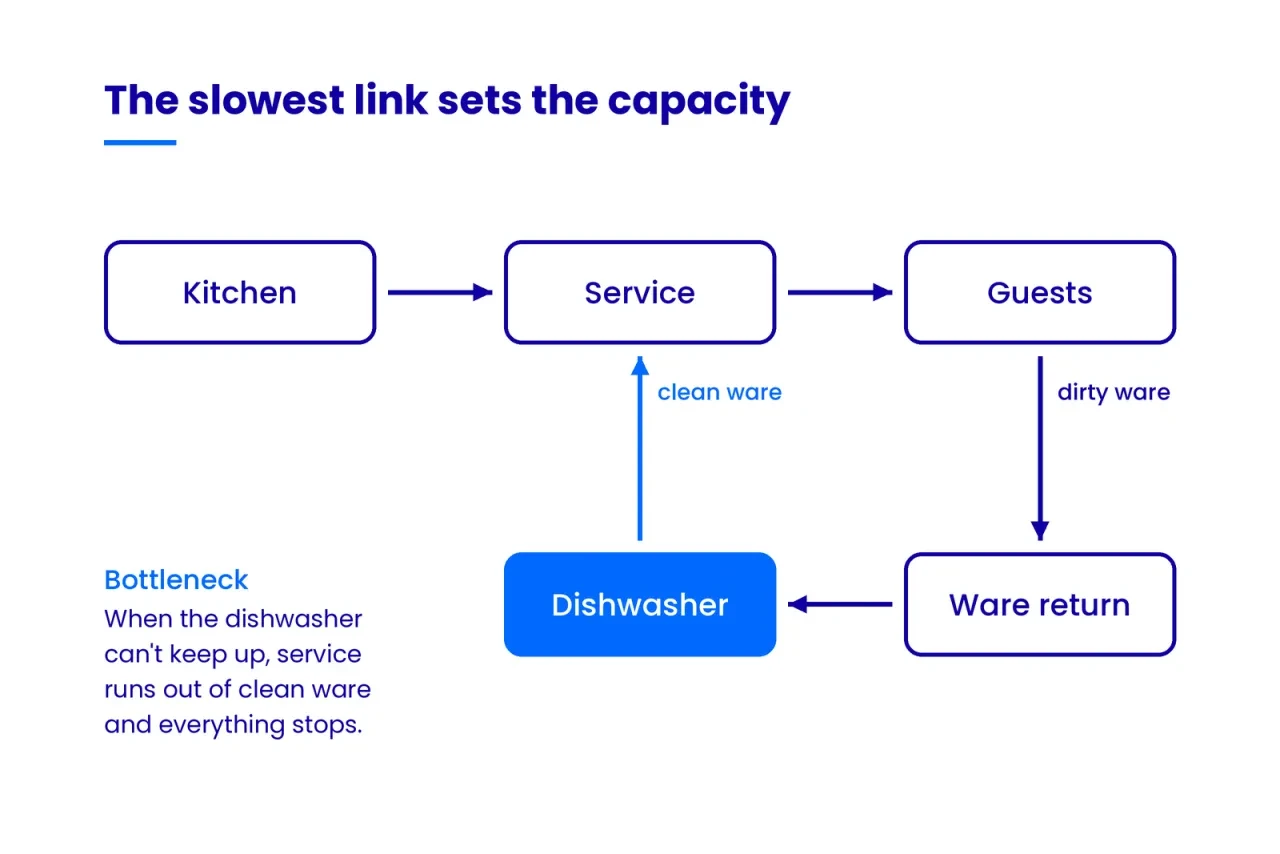
The kitchen was running flat out
An event like this quickly reveals the limits of a space. The fryers could not keep up, the combi ovens ran almost without a break, and several people were competing for every metre of worktop. Yet a technological process cannot be accelerated indefinitely if quality is to be maintained. Meat will not cook any faster just because another thousand guests are waiting in the courtyard.
Even then, I thought it was a pity that the original design had not allowed for this kind of situation. The pastry section was not under as much pressure at the time, and with suitable multifunctional equipment and prepared utility connections it could have supported the hot kitchen for a few hours. On a normal day the operation would run economically, and for a major event it could step up its output.
The bottleneck was the dishwasher
The greatest chaos, however, did not arise during cooking. It began when the dirty tableware started coming back from the courtyards. It travelled through several lifts, along long, narrow corridors and complicated routes to a flight-type dishwasher that was undersized for that volume. Tableware piled up, collection slowed down, vehicles waited and we had to bring in extra temporary staff.
You can have enough cooking capacity, excellent service and a well-coordinated team. But if the dishwasher cannot return clean tableware as fast as the service area uses it, the whole system stops.
The team managed it in the end. But that does not mean the operation was well designed. It only means that people rescued its weaknesses through sheer effort. And you cannot build on that in the long term.
What I take into every design
That is why, on every project today, I do not only ask how many meals the kitchen can cook. I also ask how many plates come back per hour, which route they take and where they will wait when the dishwasher falls behind. It is not as exciting a topic as choosing a combi oven, but it decides the outcome just as much.
Food courts work the same way, only on a larger scale. Ten tenants, one shared seating area, one lunchtime peak and often a single point where tableware and waste are returned. If that point cannot keep up, even the best kitchens of the individual tenants will not help.
Food courts are exactly what we will be discussing at the next P4G Breakfast:
When the Food Court Holds Back the Whole Project
22 October 2026, 8:30–10:30
Visionary, 7th floor, Plynární 1617/10, Prague 7
And if you are going to BIM DAY, you will find us on 20 and 21 October 2026 at stand no. 13.
Luboš Prüger
CEO, Projects 4GASTRONOMY